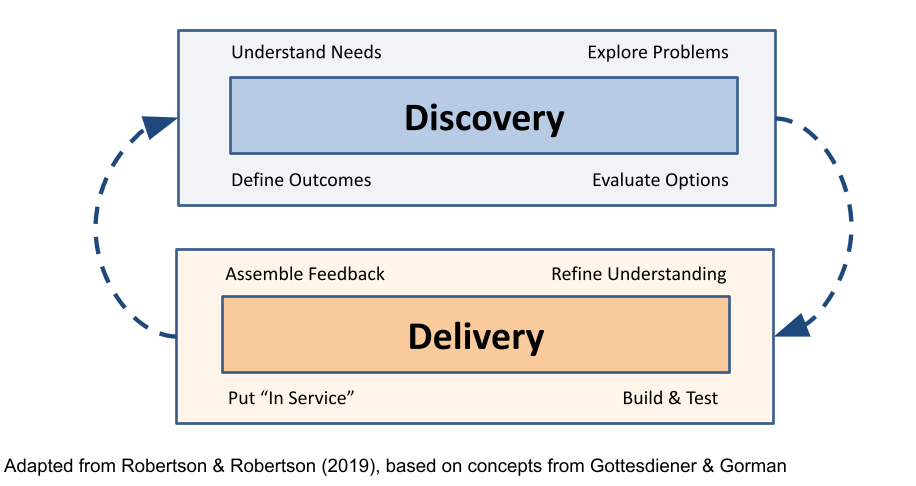
Modern organisations operate in complex, fast-moving environments where problems are rarely fully understood at the outset and certainty changes over time. In this context, discovery plays two important roles: initial discovery, to build an understanding before significant commitments are made, and continuous discovery, to refine that understanding as work progresses and circumstances evolve.
Organisations that invest heavily in delivery without equal investment in discovery often experience rework, stakeholder misalignment and solutions that fail to address the underlying problem. This course strengthens the capability to reduce that risk.
This course explores how discovery can be applied both at the start of an initiative and throughout its lifecycle. The techniques taught are deliberately method-agnostic and can be used in a range of delivery contexts, whether work is being approached in a more traditional, phase-based way or within agile and iterative environments.
The emphasis throughout is on thinking effectively about problems — not just producing artefacts — and on using discovery as a way to reduce uncertainty, align stakeholders, and make better-informed decisions about outcomes and options.
Course Duration
1 Day
Who Should Attend
This course is aimed at business analysts and related professionals who are involved in early-stage and exploratory work, including:
- Business Analysts
- Product Managers and Product Owners
- Change Managers
- Service Designers
Anyone involved in shaping initiatives before or during delivery
It is particularly suitable for practitioners who already have some experience and want to strengthen their discovery and problem-framing skills.
Entry Requirements
There are no formal entry requirements, although delegates are expected to have some familiarity with business change, product development, or service improvement environments.
Delivery and Assessment
The course is highly interactive and practical. Delegates will work through realistic examples and exercises, applying techniques as they go. There is no formal examination.
Learning Outcomes
By the end of this course, delegates will be able to:
- Understand the purpose of discovery and how it relates to delivery
- Apply discovery techniques during both initial and continuous discovery
- Explore the context in which a problem or opportunity exists
- Identify key stakeholders and understand differing perspectives
- Clarify outcomes and success measures before and during solution design
- Use a range of techniques to investigate situations where problems are unclear or contested
- Formulate clear, well-structured problem statements
- Make informed recommendations about options and next steps
Course Content
| 1. A Discovery Mindset |
| Establishing the foundations for effective initial and continuous discovery. ✔️ What is discovery? ✔️ Initial and continuous discovery ✔️ Discovery and delivery as a continuous loop ✔️ Divergent and convergent thinking |
| 2. Context: Understanding the Problem Space |
| Exploring the wider situation before committing to solutions. Understanding the Work Context ✔️ Work Context Diagrams ✔️ Business Events Understanding the People ✔️ Stakeholder Rainbow ✔️ UCOB ✔️ Introduction to Personas and Proto-personas ✔️ Introduction to Journey Mapping Understanding the Problem(s) ✔️ Five Whys (& Why Else?) ✔️ Multiple Cause Diagrams ✔️ Problem (or Opportunity) Statements |
| 3. Outcomes: Defining What Success Looks Like |
| Clarifying objectives before deciding what to build or change. ✔️ Objectives and Key Results (OKRs) ✔️ Brief Overview of Jobs to Be Done (JTBD) ✔️ Job Stories |
| 4. Options: Exploring and Learning Our Way Forward |
| Generating, evaluating and refining potential solutions. ✔️ The Brown Cow Model ✔️ The Importance of Experimenting with Prototypes ✔️ Brief Overview of Story Mapping ✔️ Role of Validated Learning |
Endorsement
We are an IIBA® Premium Training Partner